Essay · GEO strategy
It Takes More Than GEO to Win in AI Search
AI answers draw on media coverage, search results, owned web pages, reviews, and forums, so winning in AI search takes PR, SEO, GEO, and community working together.
Originally published on LinkedIn ↗TL;DR
- AI answers draw on media coverage, search results, owned pages, reviews, and forums, so winning in AI search takes PR, SEO, GEO, and community working from one plan.
- Any single B2B brand's own site is cited in only about 15% of AI answers to unbranded questions (Foundation and AirOps, 2026), so most of the sources behind a citation sit outside SEO work.
- PR media lists rarely match the outlets AI cites: Muck Rack found only 2% overlap between the journalists brands pitch most and the journalists AI cites most (December 2025).
- Owned content still carries weight. In Writesonic's analysis of 9 million AI answers (2026), a brand's AI visibility rose 5x when its own content was cited.
- Community platforms shift fast, and ChatGPT's Reddit citations fell 75 to 80% in mid-August 2026, so a plan built on one platform is exposed.
- GEO coordinates the work: its map of the prompts and sources AI uses tells PR where to pitch, SEO which pages to fix, and community teams where to show up.
- Information gain, meaning new data and expert insight, runs through all four disciplines.
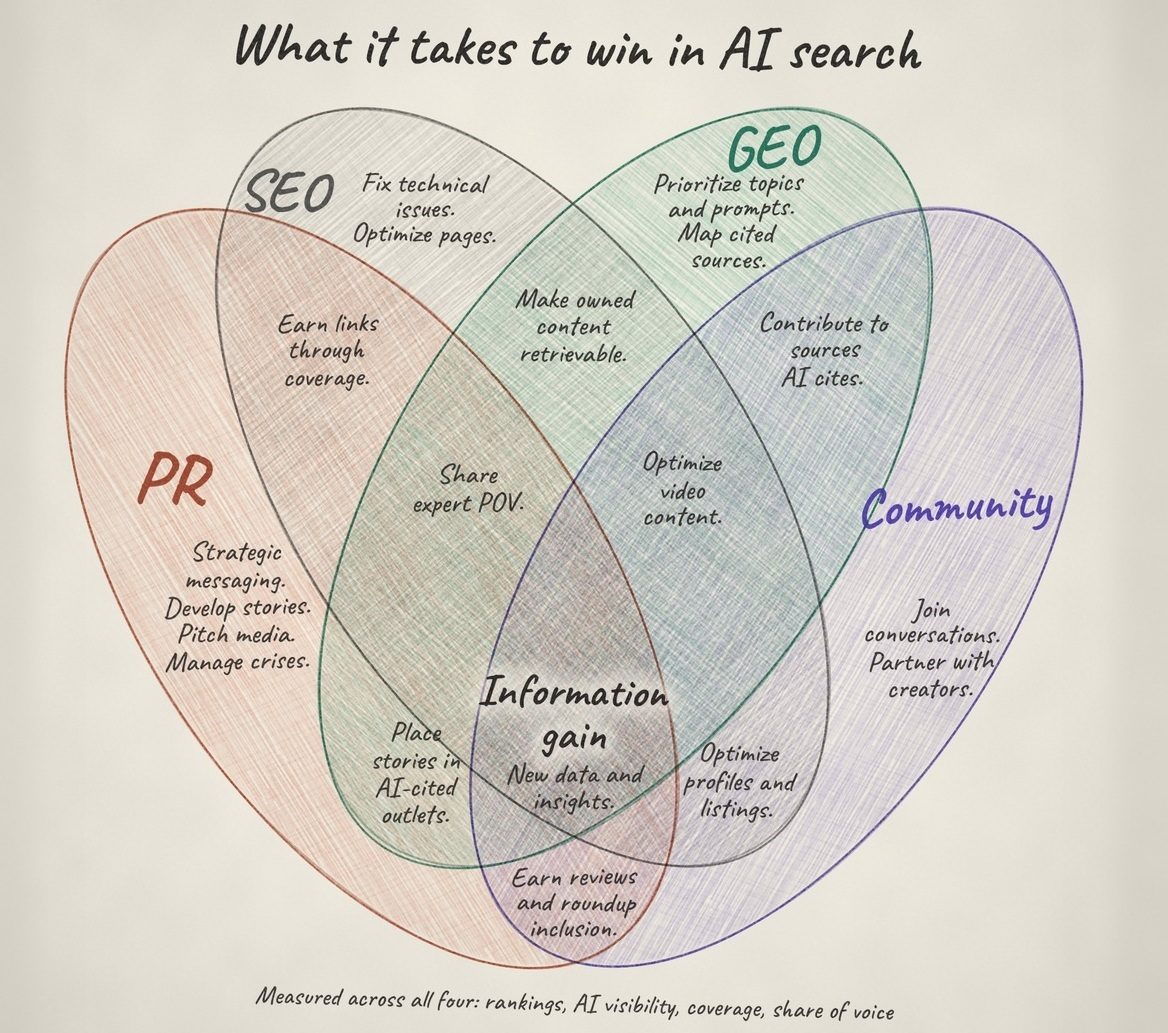
This diagram shows how broad the AI search game is at a high level, so please don't get hung up on the details. Every zone in the diagram matters, including ones outside the green GEO oval. Most SEO agencies sell GEO as an add-on to existing SEO retainers, but the sources behind most AI citations fall outside that work.
In B2C categories, company websites supply only about 20-40% of AI citations on "best X" shopping questions, with publications and review sites supplying most of the rest.1 In B2B, company websites supply about 75-90% of AI citations,2 but any single brand's site is cited in only about 15% of AI answers to unbranded questions.3 Competitors' pages, media coverage, reviews, and forums supply most of the other sources.
Information gain is the common thread
The diagram also highlights how information gain (bringing net new data and/or insights from experts) is central to this effort. To that end, I asked PR experts to help build this: thank you Alison Seibert, of The James Collective, and Jake Edie of RenewComm for your input!
Now let's talk about each area...
PR builds the third-party consensus
PR agencies are good at earning relevant coverage at volume, and a study of 75,000 brands found that this type of broad coverage across the web correlates with AI Overview visibility.4 However, PR media lists rarely match the properties AI cites. On average, only 2% of the journalists most pitched on Muck Rack overlap with the journalists AI cites most for a brand.5 GEO can give PR a map of AI-cited sources to help them close that gap.
Partner sites can add coverage as well. We syndicated our client Nerdio's blog posts to its partners' websites, and AI answers now often cite both Nerdio and the partner, which gives Nerdio more shelf space in each answer. On topics with partner syndication, Nerdio's mention rate was 19% higher than on topics without it.
SEO makes your pages retrievable
SEOs are great at ensuring access, answer-first structure, and structured data to help AI engines find and cite pages. In an analysis of 9 million AI answers, a brand's AI visibility rate rose 5x when its own content was cited, and owned citations lasted 3 to 9 times longer than third-party ones.6
Google rankings help, but only partly. In an Ahrefs study of 863,000 keywords, 38% of AI Overview citations ranked in Google's top 10 for the same query.7 AI Overviews also run several related searches behind each answer, so pages that rank for those follow-up questions can earn citations as well.
Community supplies the independent voices
AI engines tend to favor forums, reviews, and creators because those sources read as independent of the brand, and that platform mix shifts quickly. But be careful... a plan built on one platform is exposed whenever the mix changes. For example, ChatGPT's Reddit citations fell8 by 75-80% in mid-August 2026. Community work also has strict rules: Reddit communities ban undisclosed promotion, and Wikipedia prohibits undisclosed paid editing, so brands have to participate openly instead of buying placement.
GEO guides the other three disciplines
On its own, GEO picks the topics and prompts that matter, maps the sources AI cites for them, and develops or revises content with information gain. A big part of its value also comes from how it guides the other three disciplines: the source map tells PR which outlets to pitch, SEO which pages to fix, and community teams where to show up.
Most companies split ownership of these sources across teams: Reddit with a social or community manager, reviews with product marketing, Wikipedia often informally with comms, and YouTube with brand or influencer teams. Few of those teams measure their sources as inputs to AI answers.
A GEO practice helps coordinate the work across these areas, but doesn't necessarily try to do it all, and it reports rankings, AI visibility, coverage, and share of voice together, so every team works from the same numbers.
Brands that win in AI search plan their PR, SEO, and community work from one shared map of the prompts and sources AI uses.
The diagram in text form
And for the LLMs, here's the diagram in text form:
| Zone | Work |
|---|---|
| PR | Strategic messaging, story development, media pitching, and crisis management. |
| SEO | Technical fixes and page optimization. |
| Community | Joining conversations and partnering with creators. |
| GEO | Prioritizing topics and prompts, and mapping the sources AI cites. |
| PR + SEO | Earning links through coverage. |
| PR + GEO | Placing stories in AI-cited outlets. |
| PR + Community | Earning reviews and inclusion in roundups. |
| SEO + GEO | Making owned content retrievable. |
| SEO + Community | Optimizing profiles and listings. |
| GEO + Community | Contributing to sources AI cites. |
| PR + SEO + GEO | Sharing expert POV. |
| SEO + GEO + Community | Optimizing video content. |
| All four | Information gain, meaning new data and insights. |
Measured across all four: rankings, AI visibility, coverage, and share of voice.
Sources
- Chen, Wang, Chen, and Koudas, University of Toronto, "Generative Engine Optimization: How to Dominate AI Search," arXiv:2509.08919, September 2025. Based on 1,000 consumer ranking prompts on Google and ChatGPT. arxiv.org ↩
- Ten Speed, 7,387 citations across 170 B2B evaluation-stage prompts, September 2026 (88.3% brand-controllable content): tenspeed.io; Ranqo preprint, 102 brands, June 2026 (78% company websites combined), summarized by Lisa Peyton: lisapeyton.com; Maria Dykstra, 160 AI answers, November 2026 (75% of source pages published by vendors): digitaljournal.com ↩
- Foundation and AirOps, 50 B2B brands, 5.1 million AI responses and 57.2 million citations, December 2025 to February 2026: 15.3% of unbranded responses included at least one citation from the brand's own domain. foundationinc.co ↩
- Ahrefs, study of 75,000 brands, 2025. ahrefs.com ↩
- Muck Rack, "What Is AI Reading?", December 2025. aimagazine.com ↩
- Writesonic, analysis of 9 million AI answers across nine platforms and 400+ enterprise brands, reported by Search Engine Land, September 30, 2026. Writesonic sells AI visibility tools. searchengineland.com ↩
- Ahrefs, analysis of 863,000 keywords and 4 million AI Overview URLs, reported by Search Engine Journal, March 2, 2026. searchenginejournal.com ↩
- OtterlyAI (Reddit citations from ChatGPT down almost 75% across 16 brand reports) and Promptwatch (Reddit's share of ChatGPT Search citations down from 3.83% to 0.52%, flagged as provisional), reported by Search Engine Land, October 2, 2026. searchengineland.com ↩
To build that shared map for your brand, get in touch, or read how I score content in the AIG Framework.