Essay · GEO strategy
The Argument About AI Content at Scale Is Over
Six months ago this was a hot take. Now Google, its researchers, the trade press, the vendors and the practitioners agree: scaled low-effort content spikes, then collapses.
TL;DR
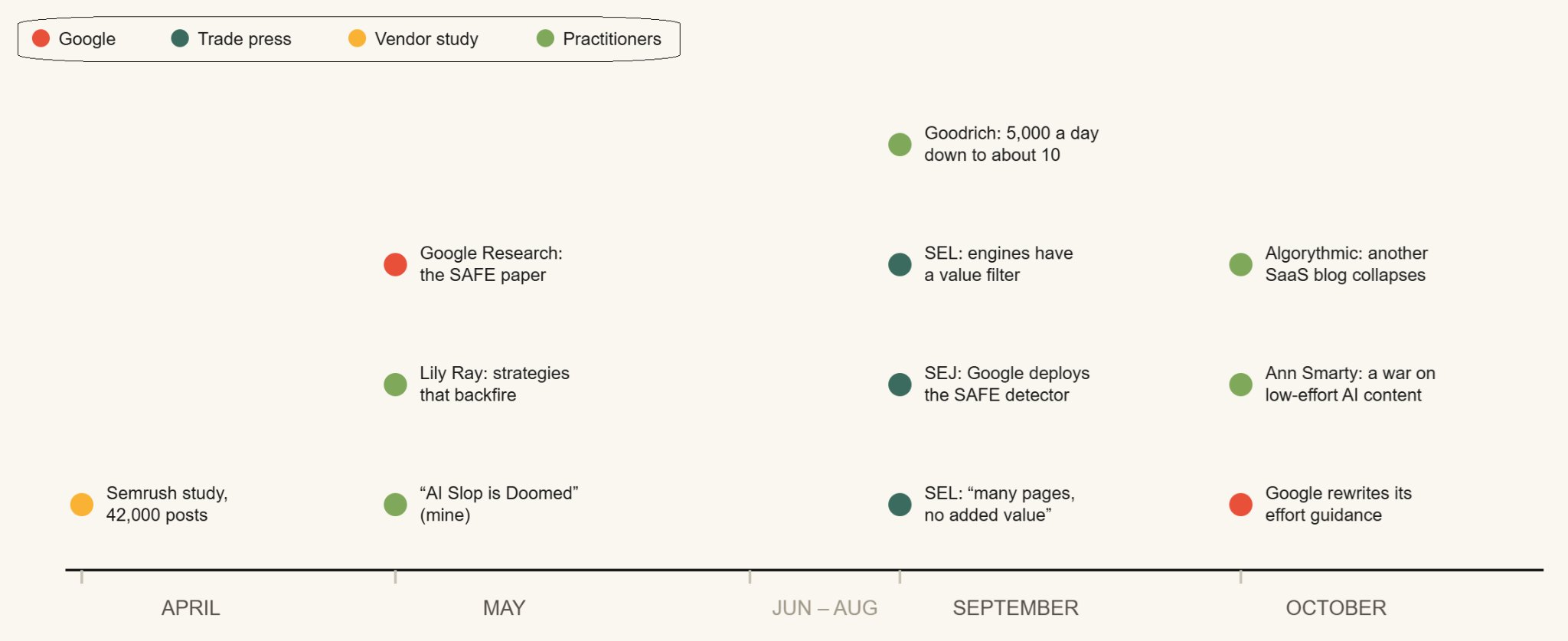
- Google's docs team, Google's researchers, the trade press, the vendors and the practitioners all converged on the same conclusion inside six months: scaled low-effort content spikes, then collapses.
- Google doesn't penalize AI writing. It penalizes AI content at scale that adds no new information.
- Google now scores effort explicitly. Its updated guidance says generative AI at volume without oversight or curation is "little to no effort," and that crediting your sources doesn't substitute for original work.
- Google is building detection for this. SAFE is the second AI-slop system it surfaced in 2026, and its own researchers use the phrase "AI slop" in the paper.
- The "but AI content ranks fine" argument is usually about a limited number of hand-reviewed articles. That isn't scale, and it isn't the thing anyone's arguing about.
- What survives is information gain: what you know that the model doesn't, and that the other retrieved pages don't say.
Recent articles and studies
- Algorythmic, 10/7/26: Yet another b2b SaaS company that got destroyed
- Ann Smarty, Smarty's Digest, 10/7/26: Google is starting a war against low-effort AI content
- Search Engine Land, 10/2/26: Generative AI at volume without oversight "represents little to no effort"
- Christian Goodrich, Return on Search, 9/29/26: Unchecked AI SEO advice took one site from 5,000 impressions a day to about 10
- Search Engine Land, 9/28/26 (seems like a counterpoint but it's not): Engines have a "does this add any value" filter
- Search Engine Land, 9/25/26: Google penalizes "many pages, no added value"
- Search Engine Journal, 9/25/26: Google deployed SAFE, its second AI-slop detection system of 2026
- Google Research, 5/28/26: SAFE paper: "AI slop" defined as mass-produced synthetic media built to overwhelm integrity systems
- r/SEO: AI SEO advice crashed a sports site
- Lily Ray study, 5/13/26: AI Content Strategies That Backfire (LinkedIn post with comments)
- Richard Roberts, 5/11/26: AI Slop Is Doomed
- Semrush study of 42,000 blog posts, 4/6/26: Human content is 8x more likely than AI to rank
Six months ago this was a hot take.
In May I wrote that AI slop was doomed. At the time that was an argument you had to make, and plenty of people in my feed read it as wishful thinking from someone with a framework to sell.
It isn't an argument anymore. Over the past six months, Google's documentation team, Google's own researchers, the trade press, the major SEO vendors and a long line of practitioners posting their client data have all landed in the same place: scaled low-effort content spikes, then collapses. Output climbs, traffic climbs with it for three to six months, then it falls back toward where it started or below it.
What's remarkable isn't the finding. It's how little daylight there is between the people reporting it. These groups disagree about a lot in search right now, but not this.
Let's be precise about what the evidence actually supports, because the sloppy version of this claim is easy to knock down. Nobody's saying Google penalizes content for being written by AI. Google has said the opposite in writing since 2023 and hasn't budged. What the evidence supports is narrower and a lot more useful: Google penalizes many pages, published at volume, that add no new information and exist to move rankings.
Below are twelve sources, all published between April and October of this year.
The evidence
Google says it in its own words
Google's updated helpful content guidance (via Search Engine Land, October 2, 2026). Google rewrote the document last week to name effort as one of the most critical factors in page quality. The operative line: "using generative AI to produce large amounts of text without manual oversight or curation represents little to no effort." It adds that attribution does not replace the need for original effort. It's the clearest statement Google has made on this, and it landed mid-rollout of a spam update.
Google penalizes many pages, no added value (Search Engine Land, September 25, 2026). The best single piece on this. It walks through the 2023 "SEO heist," in which roughly 1,800 articles generated from a competitor's sitemap pulled 3.6 million visits, about 490,000 a month, before the gains largely evaporated within months and the site landed back at or below where it started. Three for three against the scaled content abuse policy: many pages, no added value, built to manipulate rankings.
Google deployed SAFE (Search Engine Journal, September 25, 2026). Coverage of the paper below, and the detail that matters: SAFE is the second AI-slop detection system Google has surfaced in 2026, after S-CTS. Two systems in one year isn't a research curiosity, it's a resourcing decision.
The SAFE paper (Google Research, document dated May 28, 2026). Google's own researchers use the term "AI slop" and define it as mass-produced, low-quality synthetic media designed to overwhelm traditional integrity systems.
Practitioners with their own data
Yet another b2b SaaS company that got destroyed (Algorythmic, October 7, 2026). Lily Ray's traffic curves are the most legible version of this argument. If you only look at one chart, look at hers.
AI Content Strategies That Backfire (Lily Ray, May 13, 2026). The earlier study, worth reading alongside the comment thread, which is full of practitioners reporting the same shape on their own sites.
Google is starting a war against low-effort AI content (Ann Smarty, Smarty's Digest, October 7, 2026). Ann assembles the circumstantial case: the word "effort" appears 120 times in the quality rater guidelines, the contentEffort attribute surfaced in the algorithm leak, and the September spam update ran longer than any before it.
Unchecked AI SEO advice took one site from 5,000 impressions a day to about 10 (Christian Goodrich, Return on Search, September 29, 2026). Christian counted his own corrections: 487 across 3,792 messages over four months, roughly one in seven, from someone prompting these tools daily on the most capable models.
AI SEO advice crashed a sports site (r/SEO). Anecdotal and self-reported, and I'm including it anyway, because the comment threads under every post above are full of the same story.
The vendor studies
Human content is 8x more likely than AI to rank (Semrush study of 42,000 blog posts, April 6, 2026). At position one, pages graded 80.5% likely human-written and only about 10% likely AI. Read it carefully, though. The researchers themselves caution it isn't evidence that AI can't rank. A detector reads the finished product, and a page somebody genuinely worked on reads like one even when a model helped draft it. What it shows is that laziness can't hold the top of the page.
AI Slop Is Doomed (Richard Roberts, May 11, 2026). My own earlier piece, if you want the full argument and the model-collapse case behind it.
The objection you'll hear, and why it misses
Someone's going to push back with a version of this: AI content ranks fine, here's a site doing it successfully.
The strongest published form of that argument is in Search Engine Land's 7 AI search myths, debunked (September 28, 2026), which points to four fully AI-generated test articles, published across six months, that were still ranking.
I don't read that piece as a counterpoint at all. Its conclusion is mine: search engines don't have an AI penalty, they have a "does this add any value" filter. And the example doesn't test the claim on the table. Four articles with human review, built on "content that starts with a good idea, genuine expertise, original data, and a specific point of view," isn't scaled content, and it isn't low-effort.
The real question is what happens at 120 pages a quarter with no information gain.
What survives instead
If effort is what Google now scores, the practical question is what effort looks like in a draft, before you hit publish.
That's what the Active Information Gain framework measures. Four of its dimensions you can score before publishing: novelty against what a model can already write from training data alone, distinctiveness against the ten to twenty pages it retrieves today, entity exclusivity in the coined terms and proprietary statistics only you have, and definitional density in clear statements an engine can lift. Two more only become measurable once it's live: whether your content is specific enough that a model must name you to stay accurate, and whether you are named early in the answer or absorbed anonymously into it.
Scoring a draft against six dimensions forces the originality that makes content worth citing, and it catches the pages that feel original but are functionally indistinguishable from what the model already knows.
Scaling slop is easy. Scaling information gain is hard, because it depends on human input: your experts, your data, your field lessons. But that difficulty is your moat.
The window on this one is closing. Google's all over it, and the other models are playing catch-up because it's what they need to provide the best answers. At this stage, why take the spammy approach when the risks are this well documented?